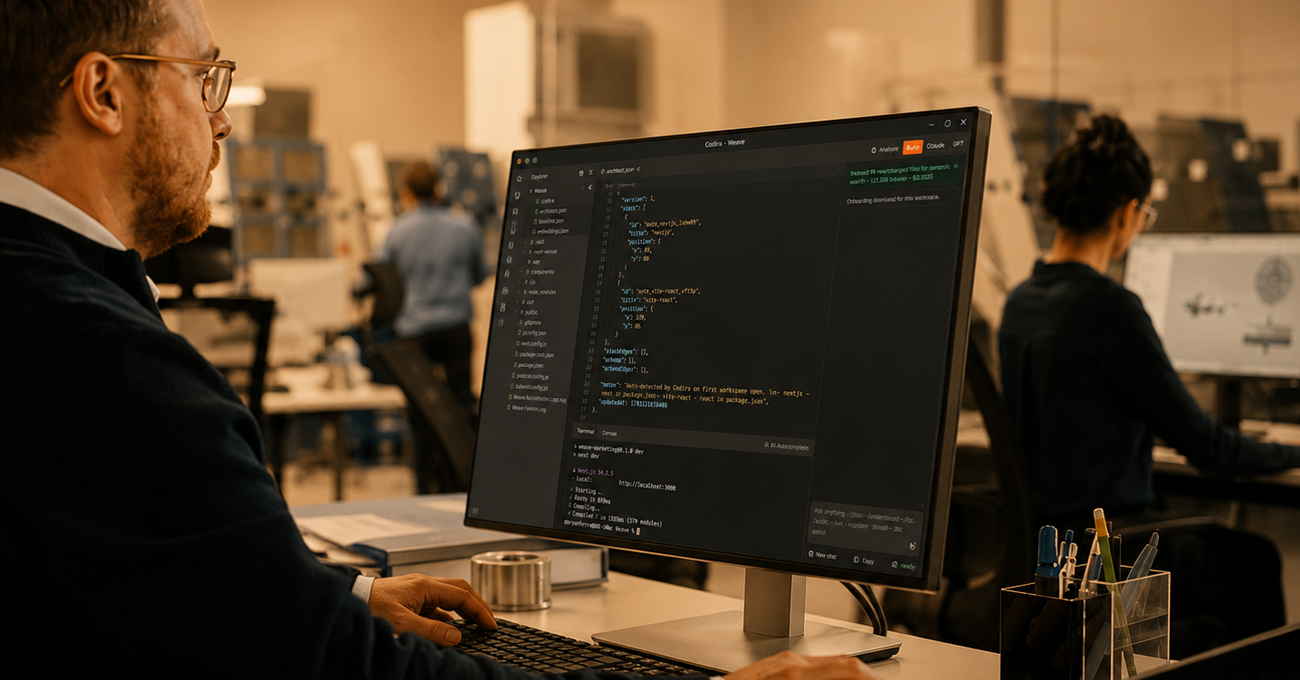
Team Standards at 500-engineer scale. One source of truth, every repo.
What ships in every Codira Team tier seat today, extended for organizations with multiple repos, multiple teams, and compliance constraints.
.codira/standards.md + per-engineer taste overlay. Every agent on every PR follows the layered context. Works on every Team tier seat in v0.11.Per-repo standards are live today— install Codira on any Team tier seat and see the three-layer style context working on a real codebase. Org- tier extensions ship 2H 2026 with the cross-project work and the analytics dashboard. Procurement can map both phases to contract terms; the roadmap doesn’t hide behind “coming soon.”
Boards are demanding more. Most orgs are doing it wrong.
Boards are demanding
- higher efficiency
- lower engineering costs
- faster release cycles
- leaner teams
- increased profitability
But most orgs are doing it wrong
- replacing engineers with unreliable ai tools
- introducing security and governance risks
- creating technical debt faster
- sacrificing quality for speed
- deploying fragmented ai workflows with no oversight
The result? More code. More chaos. More operational risk.
Not better engineering.
Built for enterprise reality.
Codira is not another ai coding assistant. It’s an enterprise-grade ai-native engineering platform designed around one principle:
ai should amplify professional engineers, not replace them.
Inside Codira, one engineer orchestrates multiple specialized ai agents simultaneously across:
Hiring one Codira engineer is like hiring ten engineers in one.
Not because ai replaces your team. Because Codira turns your existing engineers into exponentially more productive operators.
Efficiency without sacrificing quality.
Most ai coding platforms optimize for speed alone. That approach breaks at enterprise scale. Codira was built around orchestration, validation, runtime awareness, deterministic review, and human oversight from day one.
Reduce inefficiencies
Routine engineering glue work moves to agents.
Accelerate delivery
Higher throughput without sacrificing quality.
Improve leverage
One engineer ships at the throughput of a team.
Architectural integrity
Multi-agent review keeps the codebase coherent.
Preserve compliance
Security + governance baked into every workflow.
Sustain code quality
Deterministic review catches drift before it ships.
All inside one unified engineering platform.
Why current ai coding tools fall short.
Most ai coding products today are fundamentally autocomplete with a chat window.
- limited context
- isolated workflows
- weak governance
- no runtime awareness
- little enterprise infrastructure
- your organization
- your architecture
- your infrastructure
- your runtime systems
- your engineering workflows
Codira changes that.
Engineering that knows what’s happening in production.
Codira extends intelligence beyond source code into the running system — so production incidents become signals the platform investigates, not interrupts the team has to triage from scratch.
Investigate failures
Live error signals routed to the right agent.
Analyze stack traces
Trace what broke across the running system.
Validate user workflows
Drive the real app to verify behavior end-to-end.
Inspect deployments
See what shipped and how it’s behaving.
Diagnose runtime issues
Pull signal out of high-volume log streams.
Coordinate fixes
Route failures back into the next plan automatically.
A fundamentally more intelligent operational workflow than
traditional developer tools.
Built for enterprise governance from day one.
Large organizations require oversight, auditability, approvals, compliance, and infrastructure control. Codira was designed around those requirements — not bolted on after.
- patch approval systems
- human-in-the-loop
- role-based permissions
- runtime visibility
- audit logging
- secure execution
- private model support
- local deployment
Operationalize ai-native engineering workflows at scale — safely and responsibly, without the “shadow ai” risks of individuals wiring up tools on their own.

Collaborative intelligence. Not one model doing everything.
Most ai coding platforms rely on one model trying to do everything. Codira orchestrates multiple specialized ai systems collaboratively.
Planner
Reads the stack and drafts the change as a structured plan.
Implementation
Writes the patch from the plan; the only agent that touches code.
Reviewer
Verifies the diff matches the plan and the goal, blocks drift.
Security
Scans for credential leaks, injection paths, unsafe patterns.
QA / UAT
Drives the running app to verify the change actually works.
Runtime Monitoring
Watches logs and runtime signals; feeds failures into the next plan.
The result: stronger reliability, better code quality, faster debugging, safer ai workflows.
Measurable business outcomes.
Software organizations globally are under pressure to do more with less. Codira directly improves engineering leverage, deployment velocity, operational efficiency, and team scalability.
Increase profitability without compromising engineering excellence.
Built for the ai-native enterprise.
The platform is fully model-agnostic. Future-proof your enterprise ai strategy while reducing dependency on any single provider.




Run Codira against models that never leave your infrastructure, on-prem, VPC, air-gapped, or your own private inference cluster.
Hybrid deployments
Run anywhere your data needs to live.
Sovereign ai infra
VPC, on-prem, or air-gapped inference.
Enterprise orchestration
Plug into the systems your platform team already runs.
No vendor lock-in
Swap the model for any role without touching the workflows.
Lean, high-output teams orchestrating intelligent systems.
The future enterprise engineering organization won’t consist of massive teams with disconnected workflows and isolated ai tools. The future belongs to lean, high-output teams orchestrating intelligent systems inside ai-native collaborative environments.
Codira is building the operating system for that future. Your best engineers are still your greatest asset. Codira simply gives them the leverage of an entire ai-powered engineering organization.

One engineer. Infinite scale.
The operating system for ai-native software engineering.